Imagine you have exactly $15,000 to invest in autonomous infrastructure this year, and you can only build one agentic AI system. Do you build the Sales Engine, or do you build the Marketing Engine?
Many founders instinctively choose sales because it sits closer to the revenue line. But when we look at the actual system design, the unit economics, and the data pipeline of both architectures, the answer becomes a math equation.
Let's run the architecture for both and see what actually happens.
1. The Agentic Sales System: The Event-Driven Engine
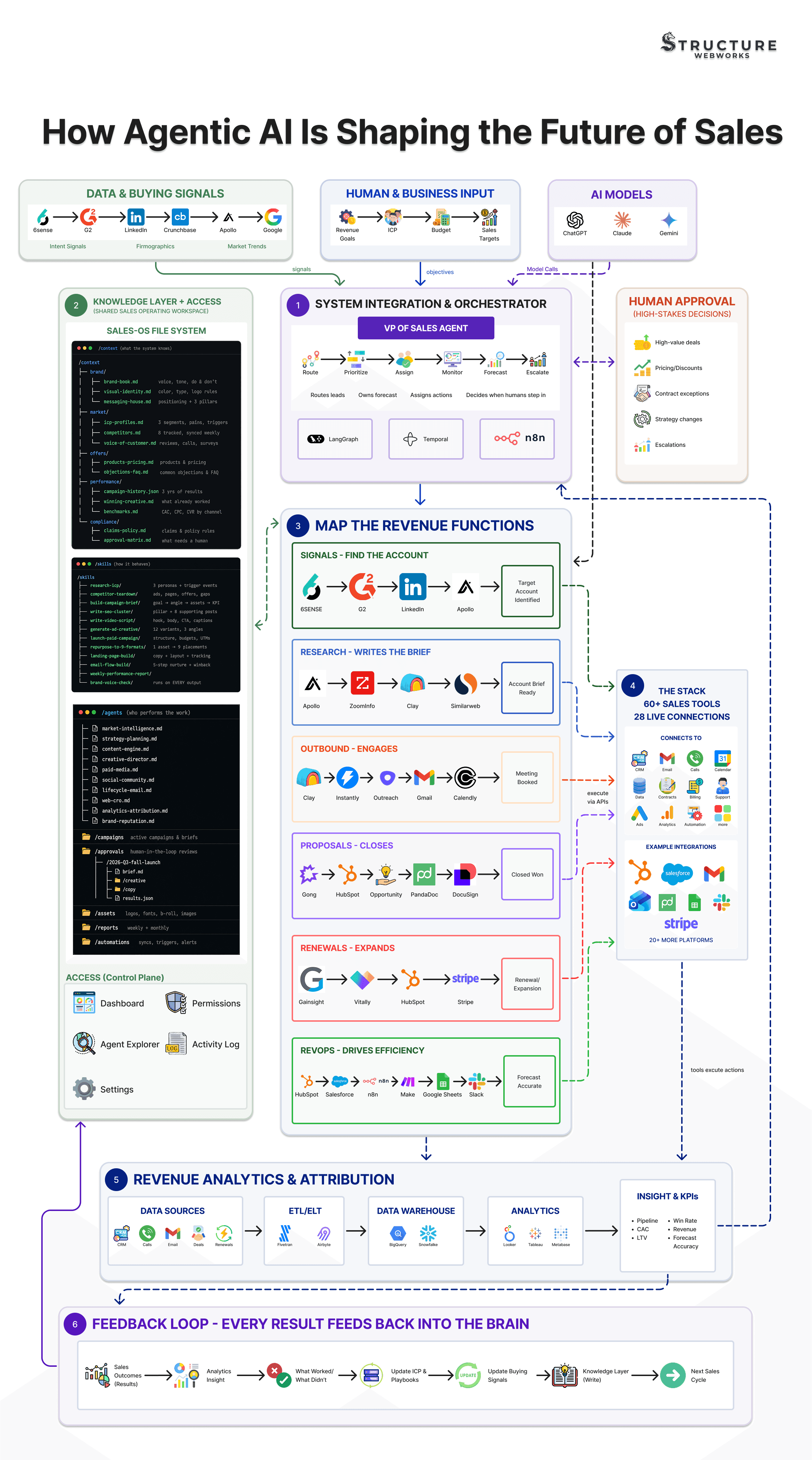
If you build the sales architecture, you are deploying a highly targeted, 1-to-1 execution machine.
- The Infrastructure: 12 specialized agents, 60 tools, and 28 live API connections mapped directly into your CRM (HubSpot), data providers (Apollo, Clay), and conversational intelligence (Gong).
- The Pipeline: Signals monitor the web to find the account. Research scrapes the data and writes the briefing. Outbound engages the prospect. RevOps keeps the data clean and the forecast honest.
It is a beautiful system, and it genuinely works. But here is the brutal math of cold outbound: Even with highly personalized AI, cold outbound replies hover at roughly 1%. If your agents send 2,000 emails a month, that yields 20 replies. Those 20 replies might convert into 4 booked meetings. Those 4 meetings result in 1 closed deal.
2. The Agentic Marketing System: The Fan-Out Engine
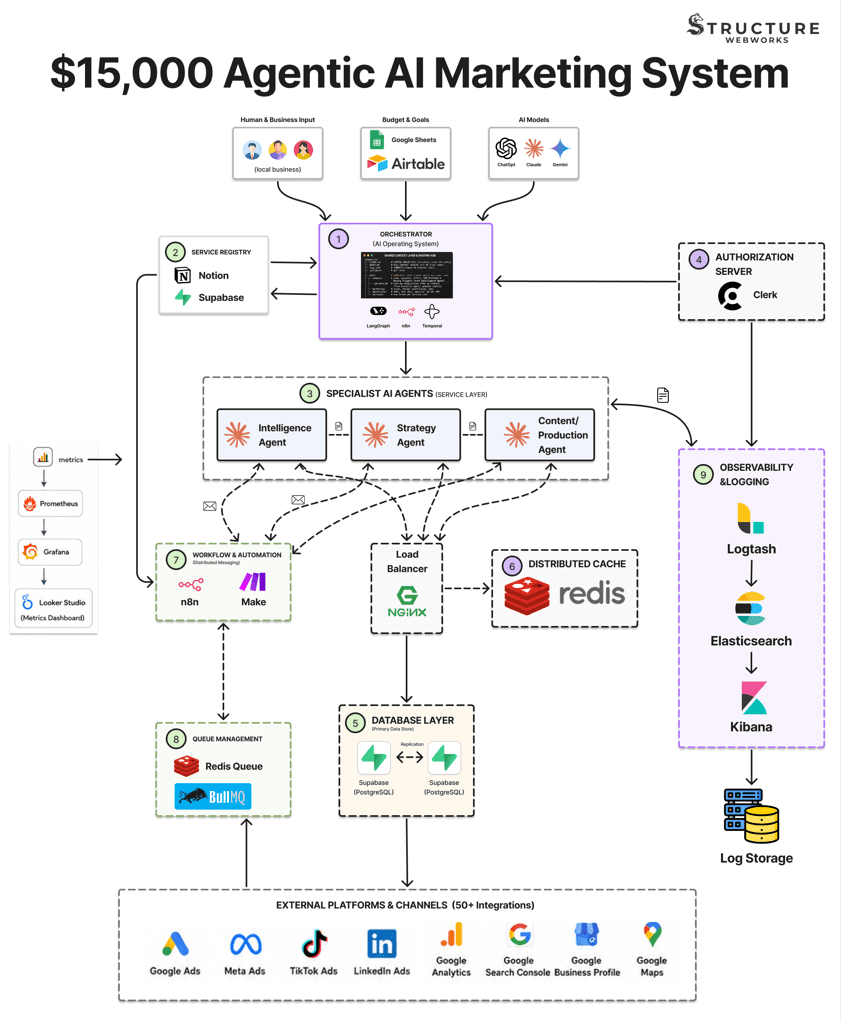
Now, let's look at the marketing architecture.
- The Infrastructure: 10 specialized agents operating across 50+ platforms.
- The Pipeline: The Intelligence Agent reads competitor ads, your past reviews, and your transcribed sales calls. It doesn't just guess; it writes data-backed Ideal Customer Profiles (ICPs) and buying triggers into a shared context folder. Production ships the assets based on that context.
- The Closed Loop: Every single night, Analytics pulls ad spend from Meta and Google, matches it against closed revenue from your CRM, and writes the exact cost-per-acquisition back into the Intelligence module.
This architecture hands you five times the lead volume.
3. The Core Difference: Fan-Out vs. Event-Driven
The choice between these two systems comes down to understanding how they process data and generate leverage.
- Marketing is "Fan-Out": You publish one asset, and it reaches everyone. It is a compounding architectural asset. The operational trade-off? It takes about 90 days for the data loop to prove its ROI.
- Sales is "Event-Driven": It is a 1-to-1 sniper approach. It triggers based on specific events: a new executive hire, a funding round, or a pricing page visit. One agent targets one account. It moves the needle this quarter, but it can only execute against demand that already exists. It does not create new demand.
Conclusion: The Decision Matrix
So, which $15,000 system do you build? You don't guess; you pull last month's operational data.
- If you look at your pipeline and realize you do not have enough leads entering the system: Build Marketing.
- If you look at your CRM and see a graveyard of leads you never had the operational capacity to follow up on: Build Sales.