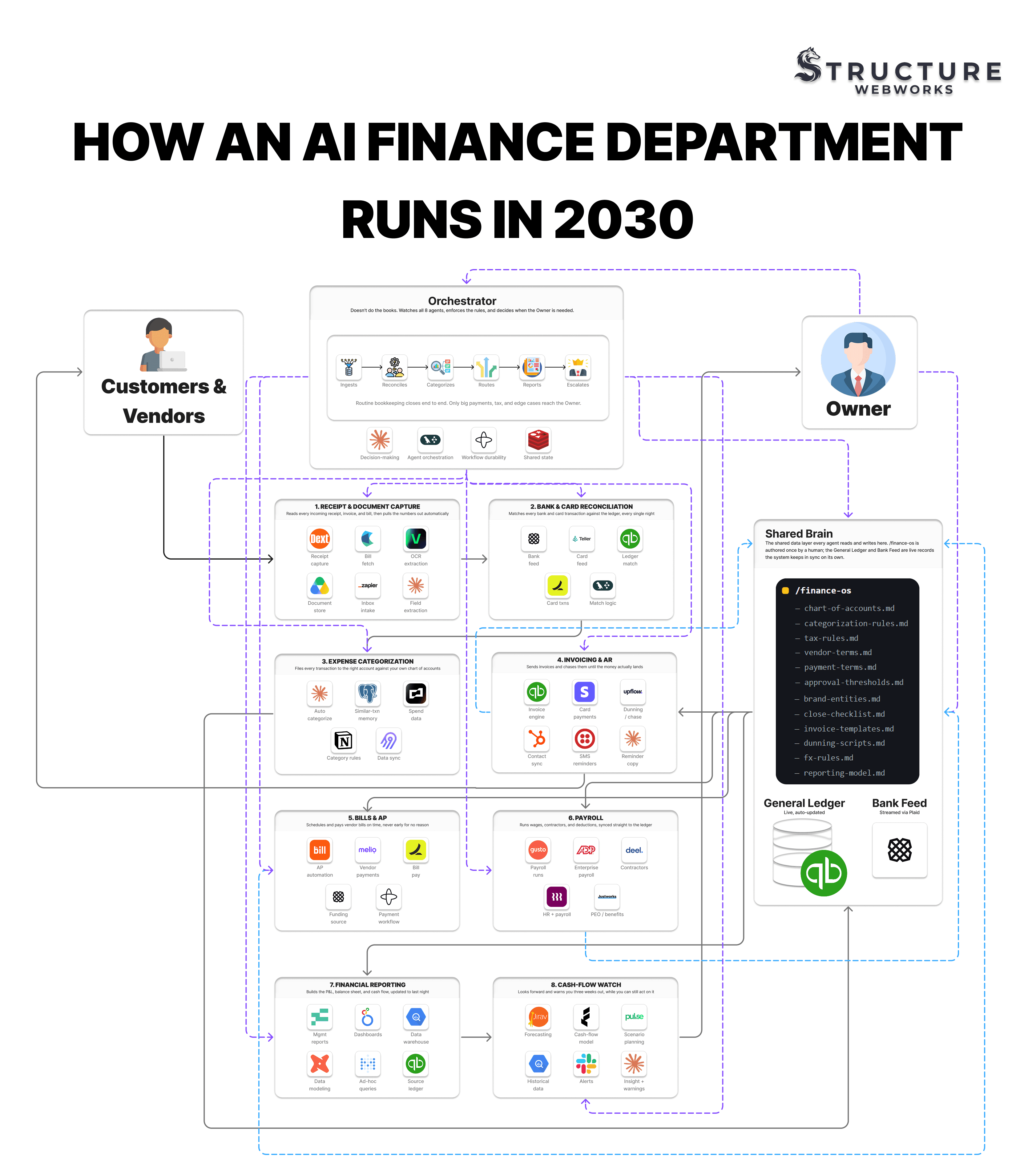
This is what an agentic AI finance department for a business actually looks like in 2030. The thing that changes by 2030 is not that software gets smarter in isolation. It's that finances stop being ten separate logins and start passing data to each other. A finance department is really eight stages that form a loop: capture, reconcile, categorize, invoice, pay, payroll, report, forecast, and then forecast feeds capture again. Below is how each stage works, written for two audiences at once: the business owner who wants to know what it does, and the engineering team that needs to know how it's built.
Capture and Reconcile: the books close every night
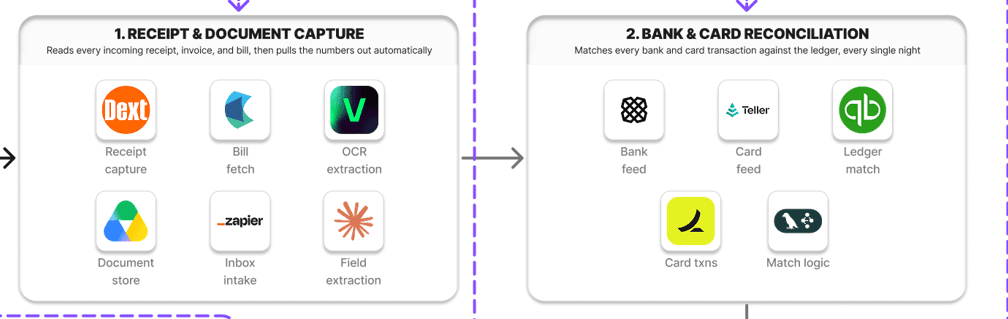
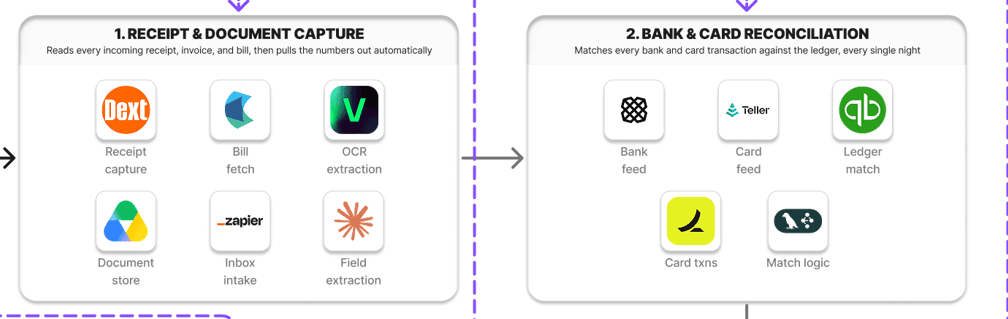
It starts at the receipt. A charge hits the business card. Dext reads the receipt the second it's photographed: the vendor, the amount, the tax. Plaid pulls the bank feed in live. QuickBooks matches every transaction against the ledger overnight, and Claude categorizes whatever doesn't auto-match, against the business's own chart of accounts, not a generic one. By morning the books are closed. Not at month end. Every single night.
How it's built: the Receipt and Document Capture module runs Dext for receipt capture, bill fetch, OCR extraction, and field extraction, with a document store and inbox intake feeding it. Bank and Card Reconciliation streams the bank and card feeds through Plaid and Teller, then runs ledger matching in QuickBooks with match logic on top. Expense Categorization uses auto-categorization by Claude, similar-transaction memory, and category rules read from the shared knowledge layer. Everything writes to one General Ledger that stays live.
Invoice and Collect: getting paid stops being a chore
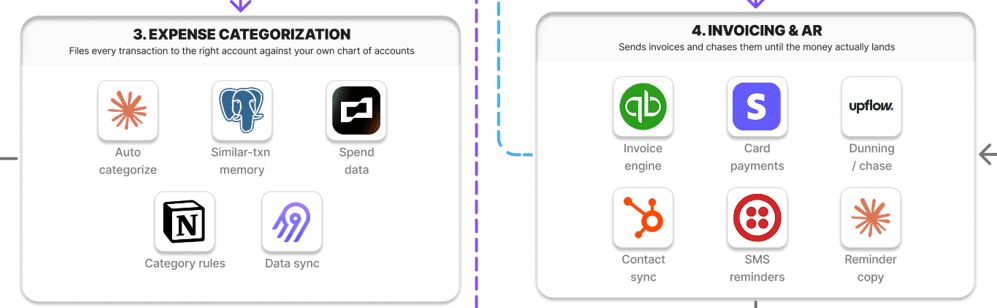
The job is done. Now the clock starts on getting paid. QuickBooks fires the invoice the moment the work is marked complete. Stripe takes the card. And if the customer doesn't pay, the system doesn't wait for anyone to remember. It chases, a nudge at day three, day seven, and day fourteen, each one in the brand voice, until the money lands. Bill.com runs the other direction, scheduling what the business owes vendors so nothing is late and nothing gets paid early for no reason.
How it's built: the Invoicing and AR module pairs an invoice engine with card payments and a dunning and chase sequence, plus contact sync, SMS reminders, and reminder copy generated against the brand voice. Bills and AP runs AP automation, vendor payments, and bill pay through Bill.com and Melio, with a defined funding source and payment workflow. Approval thresholds in the shared knowledge layer decide what proceeds automatically and what stops for a human.
Report and Forecast: it warns before the problem, not after
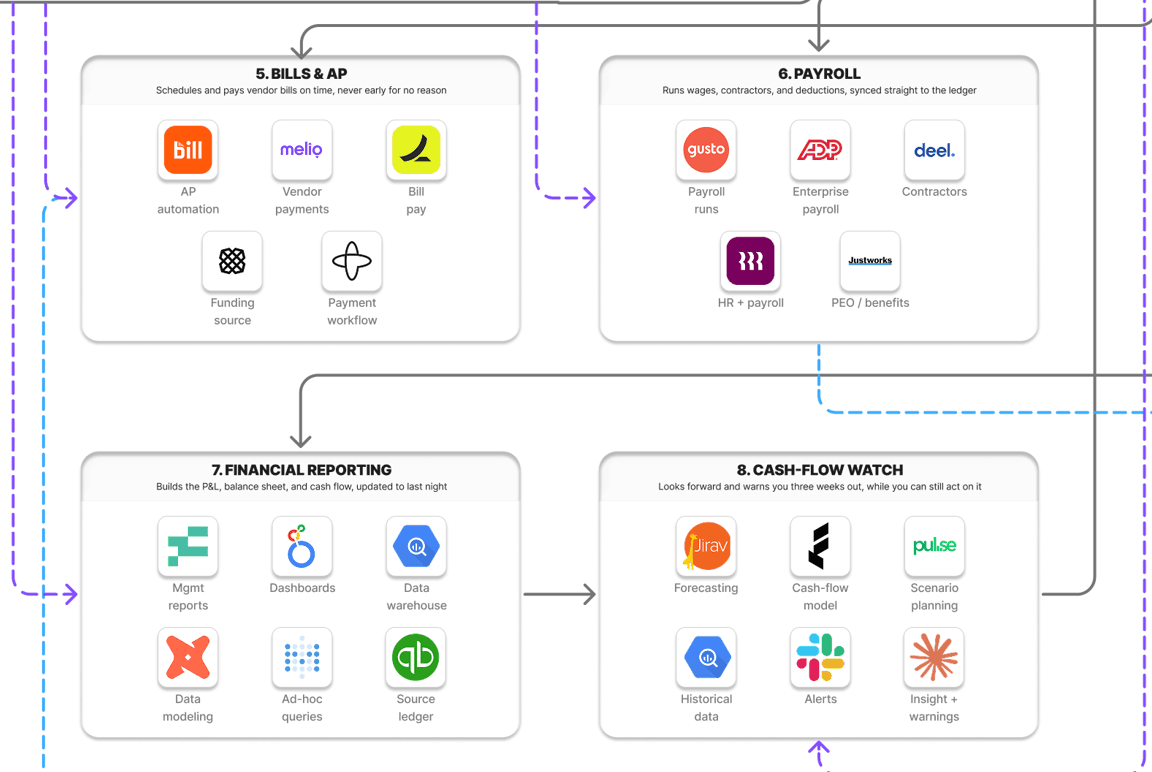
Month end used to be a scramble. Here is what actually changed. Fathom has already built the P&L, the balance sheet, and the cash flow, updated to last night. Claude reads it and flags what moved: which cost crept up, which client is slow to pay. And this is the part that matters, it looks forward. It tells the owner three weeks out that cash is going to be tight, while there is still time to do something about it. Payroll runs through Gusto, sales tax through Avalara, all tied back to the same ledger.
How it's built: Financial Reporting builds management reports, dashboards, and data models over a data warehouse and the source ledger. Cash-Flow Watch runs forecasting, a cash-flow model, scenario planning, and historical data, then pushes insights and warnings out through alerts. Payroll runs wages, contractors, and deductions through Gusto and syncs straight to the ledger. Because the forecast feeds back into capture, the loop closes and stays current.
The layer that makes it one system
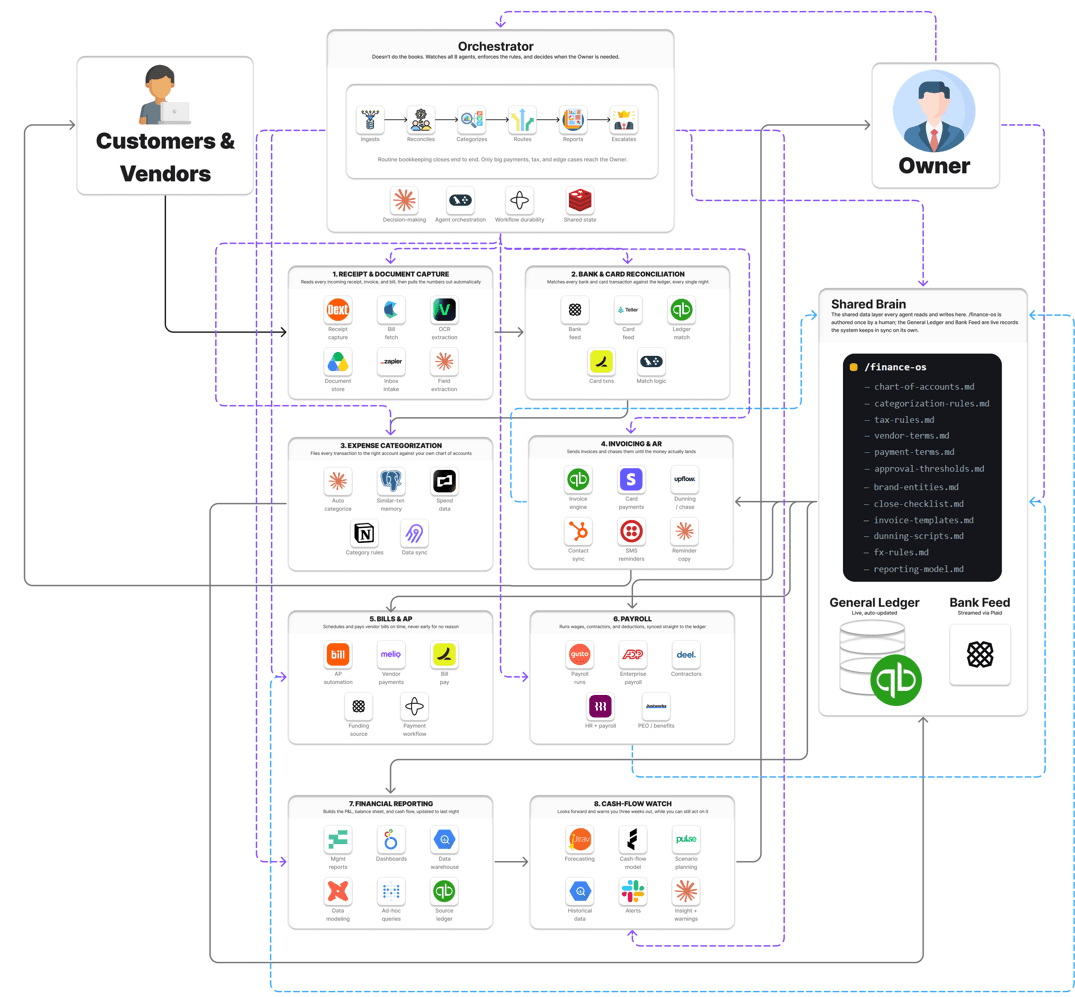
None of it works if the tools don't talk to each other. So one layer sits on top: an Orchestrator wired into the ledger, the bank, and the CRM. It doesn't do the books. It routes the work, holds the rules, and decides what needs a human.
How it's built: the Orchestrator pipeline is Ingests, Reconciles, Categorizes, Routes, Reports, Escalates, with decision-making, agent orchestration, workflow durability, and shared state underneath. Routine bookkeeping closes end to end. Only big payments, tax, and edge cases reach the owner. The Shared Brain is the data spine: a human authors the /finance-os files once (chart-of-accounts, categorization-rules, tax-rules, vendor-terms, payment-terms, approval-thresholds, close-checklist, and more), while the General Ledger and Bank Feed are live records the system keeps in sync on its own.
Why this matters for B2B
The owner still approves the big payments and signs off on the tax. They just stopped doing the data entry. That is the real shift, and it's an architecture decision, not a tool purchase: separate the work that scales infinitely (capture, reconciliation, categorization, invoicing, dunning, reporting) from the small set of judgment calls a person should always own. Get that boundary right, and the finance function runs itself most of the month, with a full audit trail and a human gate on anything that carries real risk.