This is the secret to building a one-person company that runs like it has 23 employees. Thirty-six agents handle the entire marketing function: the research, the content, the posting, the email, the numbers. And the reason it works is a reframe. Marketing isn't a funnel. It's a loop. Research finds the angle, content writes it, creative designs it, distribution ships it, audience keeps them coming back, and analytics reads what worked, which then decides next week's content. A whole marketing team used to sit in the middle of that loop. Below is how the system runs it instead, written for two audiences at once: the owner who wants to know what it does, and the engineering team that needs to know how it's built.
Research and Content: the angle finds itself
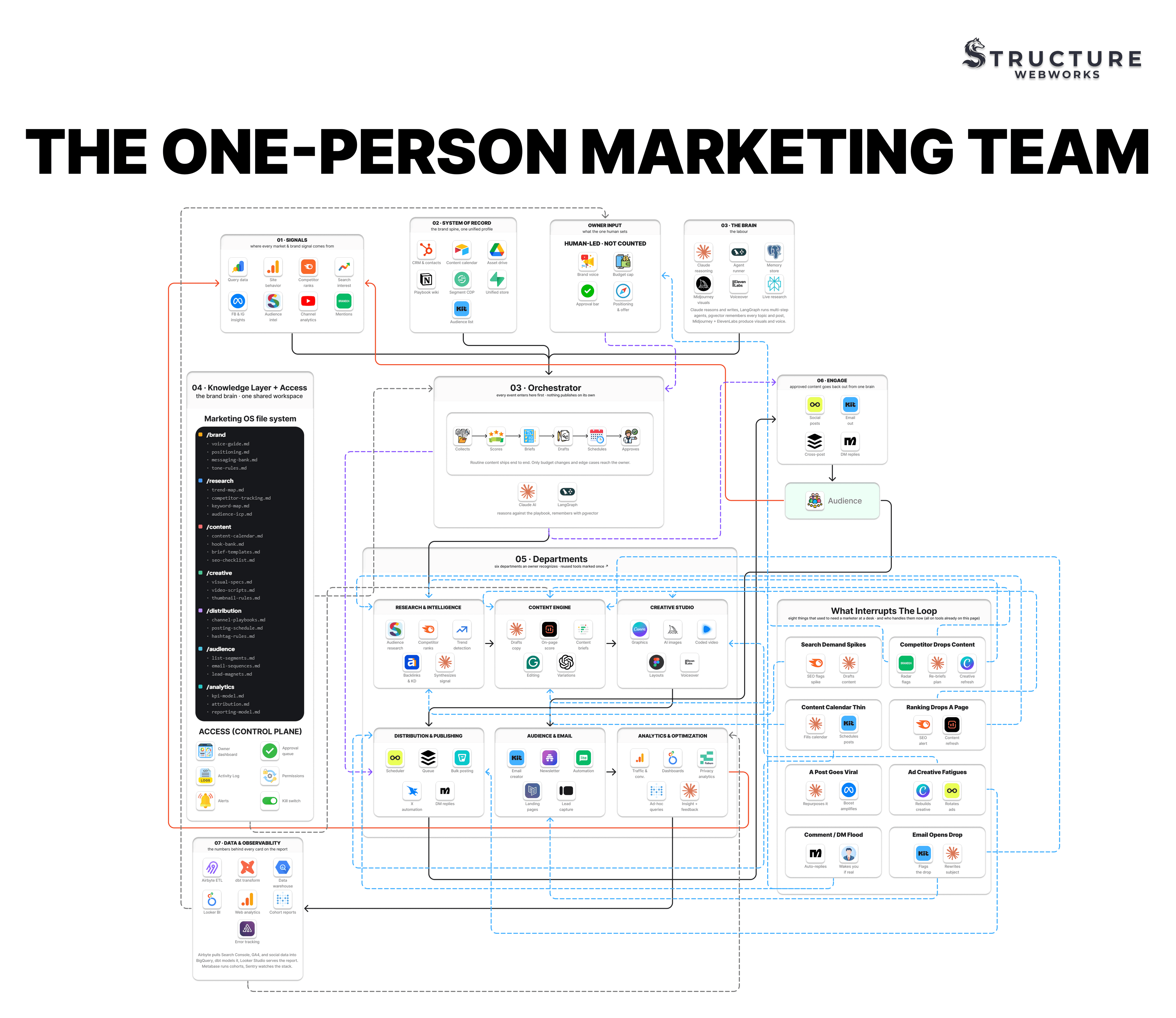
A topic starts spiking, and the brain already knows. Google Trends, Semrush, and SparkToro all feed the same brain. It reads what's trending and what the audience actually cares about, off a file written once. Claude writes the post. Surfer makes it rank. Then it stops, because the final yes still belongs to a human.
How it's built: the Research and Intelligence department runs audience research, competitor ranks, trend detection, backlinks and keyword difficulty, then synthesizes the signal. The Content Engine takes it from there with drafts copy by Claude, an on-page score from Surfer, content briefs, editing, and variations. Both read from the shared Marketing OS: the /research, /content, and /brand files that hold the voice, the positioning, and the trend map.
Creative and Distribution: the visible part, with no editor
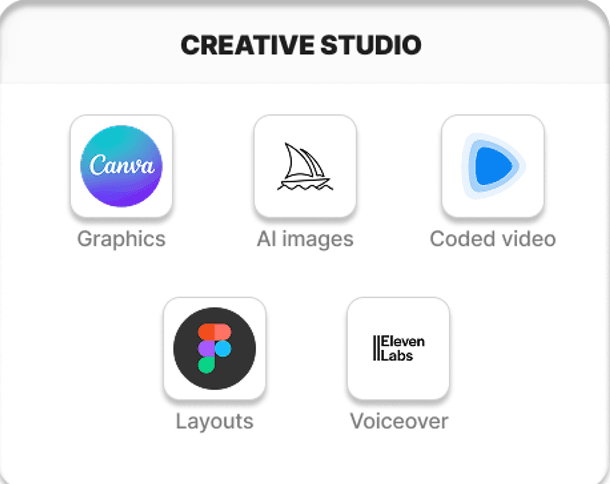
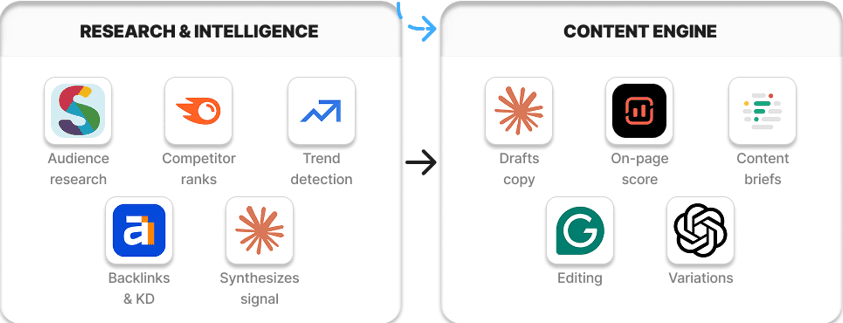
Canva and Midjourney build the graphic. Remotion renders the short in code. ElevenLabs does the voice. No editor in the loop. Metricool schedules it across every channel, at the hour each one actually lands. A comment or DM comes in, and ManyChat grabs it and replies in the brand voice before anyone has opened the app. Nobody logs in.
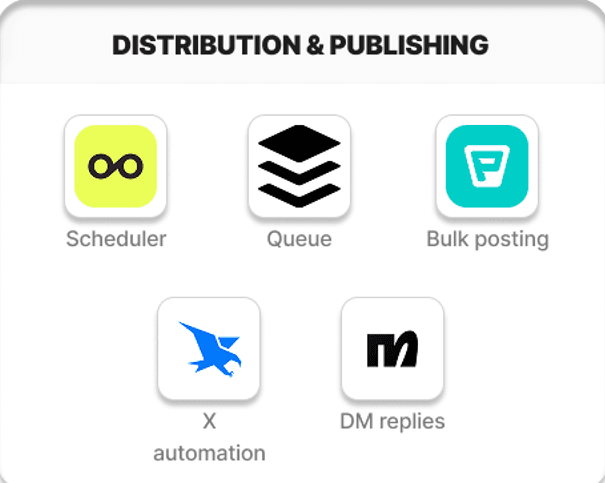
How it's built: the Creative Studio handles graphics, AI images, coded video, layouts, and voiceover. Distribution and Publishing runs a scheduler, a queue, bulk posting, X automation, and DM replies. Audience and Email covers the email creator, newsletter, automation, landing pages, and lead capture. Everything routes through one approval queue so nothing publishes on its own.
Analytics: not a report, just what happens after every post
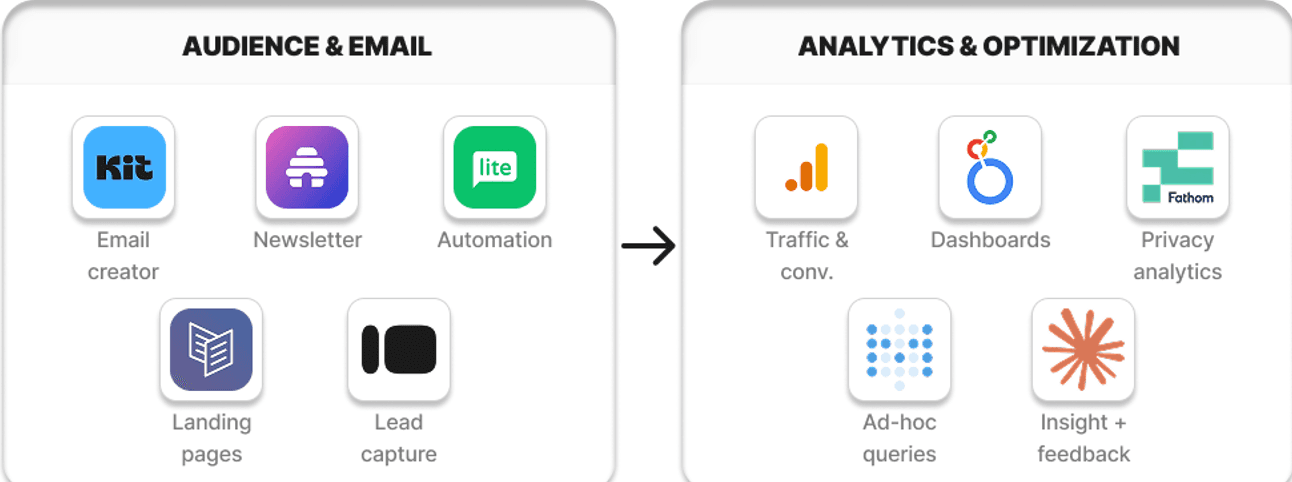
Analytics isn't a report anymore. It's what happens automatically after every post. Looker Studio reads what converted: the post that booked calls, the email that got opened. Then it checks what was made against what actually worked and feeds that straight back into research. Next week the system makes more of what worked. Nobody builds a spreadsheet.
How it's built: Analytics and Optimization tracks traffic and conversion, dashboards, privacy analytics, ad-hoc queries, and insight plus feedback. Underneath, the data layer runs Airbyte pulling Search Console, GA4, and social data into BigQuery, dbt modeling it, Looker Studio serving the report, Metabase running cohorts, and Sentry watching the stack. The feedback loop back into research is what makes the whole thing a loop instead of a funnel.
The layer that makes it one system
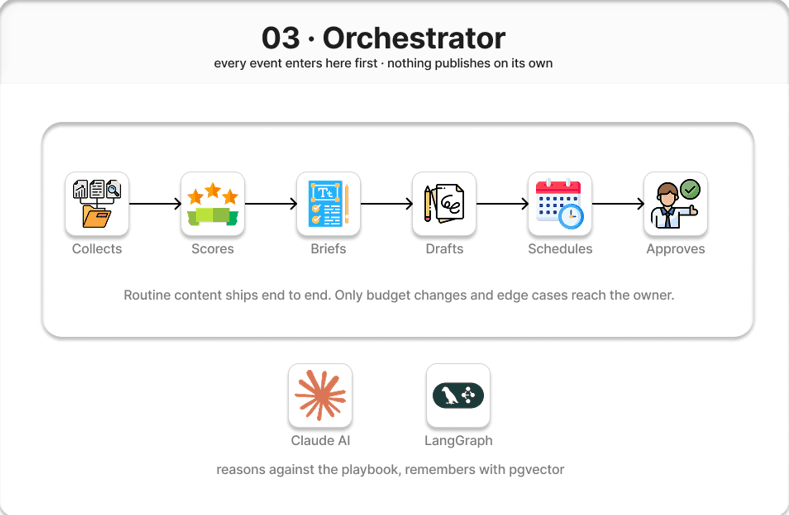
None of this works if the tools don't talk. So one layer sits on top: Claude Code, over MCP, wired into the CRM, the calendar, and the channels. And underneath it, plain files: the voice, the offer, the rules. AI moves the information. The human moves the brand and the budget.
How it's built: the Orchestrator pipeline is Collects, Scores, Briefs, Drafts, Schedules, Approves, reasoning against the playbook with Claude and remembering with pgvector. Routine content ships end to end. Only budget changes and edge cases reach the owner. The control plane gives the owner a dashboard, an approval queue, an activity log, permissions, alerts, and a kill switch.
Why this matters for B2B
The owner still owns the final yes, the brand, and the budget. Everything between the idea and the published post runs without them. That is the real shift, and it's an architecture decision, not a stack of subscriptions: separate the work that scales infinitely (research, drafting, design, scheduling, reporting) from the small set of judgment calls a person should always own. Get that boundary right, and one person runs the output of a full marketing team, with a feedback loop that gets sharper every week and a human gate on anything that carries the brand's name.