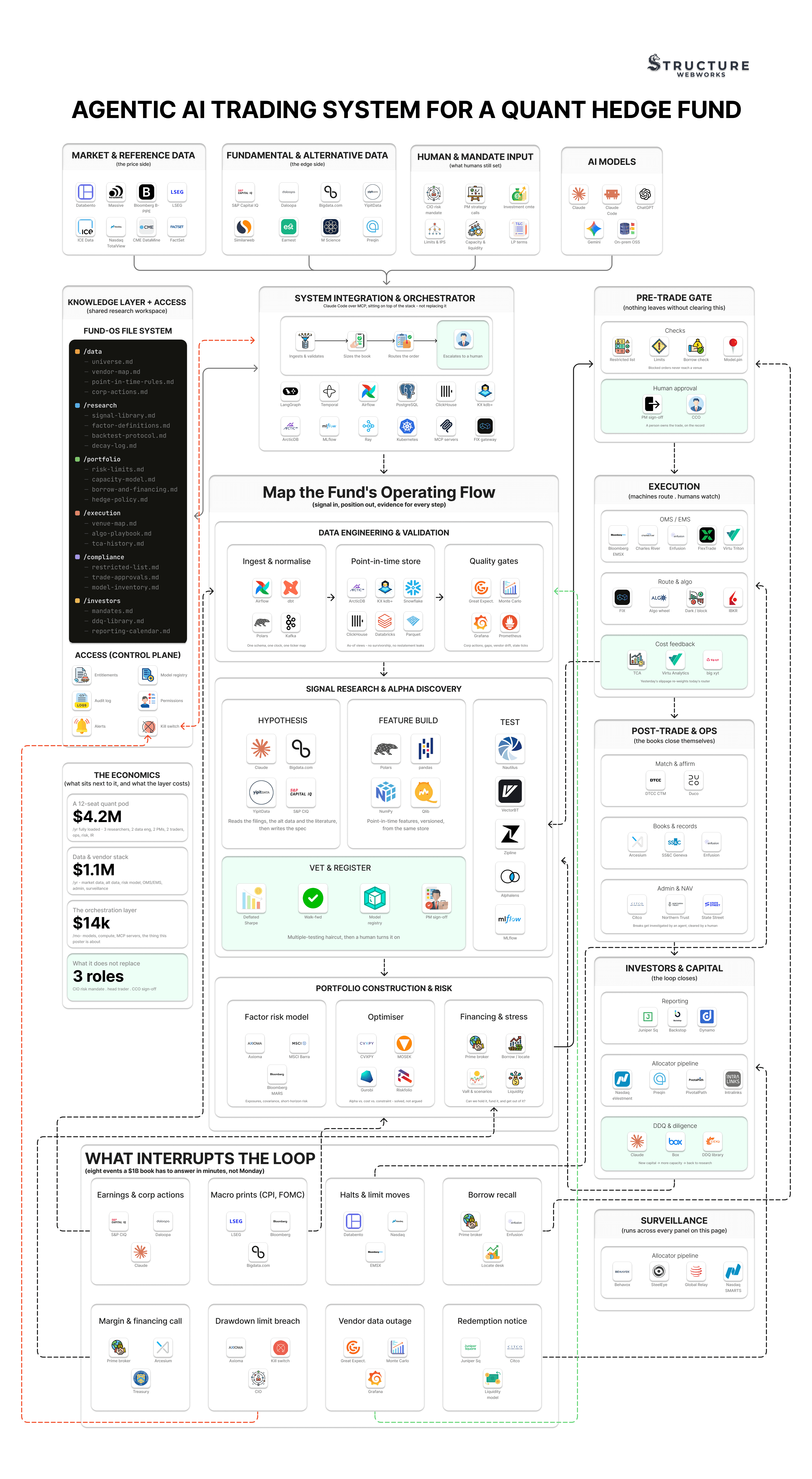
When most people hear "AI in finance," they picture a simplistic algorithmic trading bot attempting to day-trade the market. That is not how institutional capital operates.
A true quantitative hedge fund is not a single algorithm; it is a rigorous, continuous loop spanning data ingestion, research, risk management, portfolio construction, and execution. What we have built here is an Agentic AI Operating Layer that sits on top of this entire lifecycle.
Here is the architectural breakdown of how Claude orchestrates a quant fund's pipeline, acting as the cognitive engine without ever breaking the strict deterministic rules of institutional execution.
1. Signal Research & Alpha Discovery (The Hypothesis Engine)
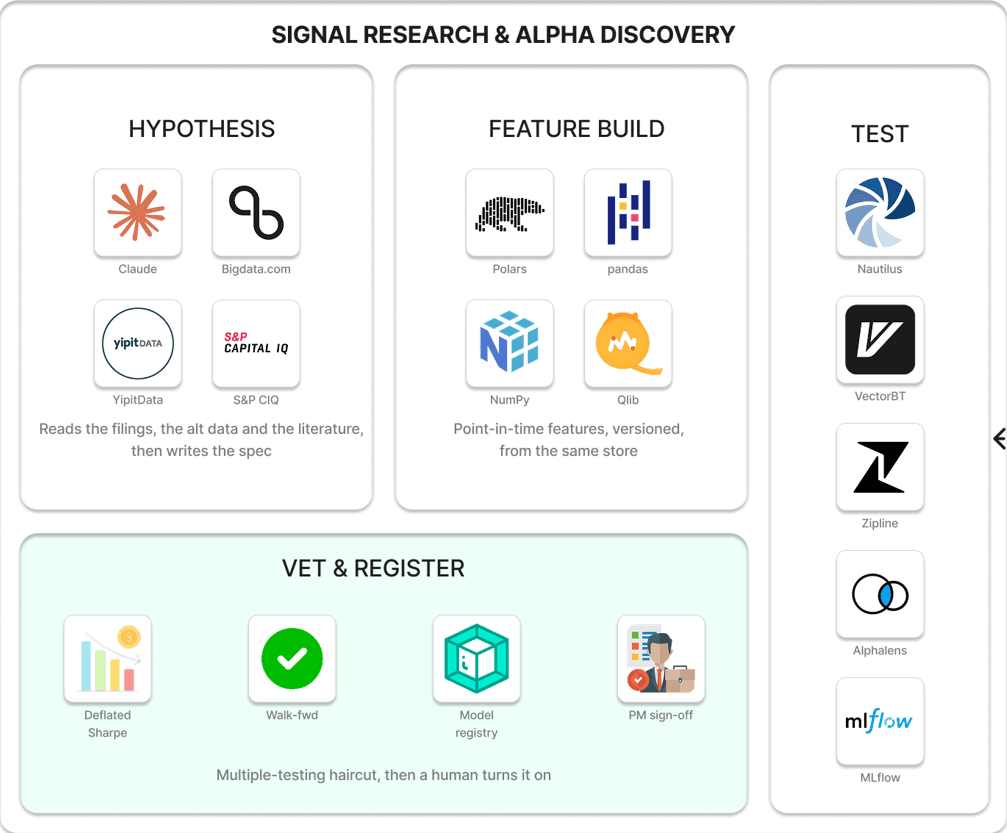
The foundation of any quant fund is data, stored strictly "point-in-time" to prevent look-ahead bias.
- Data Ingestion & Specs: Claude autonomously reads SEC filings, alternative data feeds, and macroeconomic news, subsequently drafting the quantitative specification.
- Feature Building: It builds the features point-in-time—meaning the backtest only has access to the exact data that was knowable on that specific historical day.
- Backtesting & Verification: The hypothesis is tested in Nautilus, with the cost of borrow and market impact fully priced in.
- The Human Gate: The AI does not blindly deploy code; a human quantitative researcher reviews the findings and manually turns the signal on.
2. Portfolio Construction & Risk (The Capital Allocator)
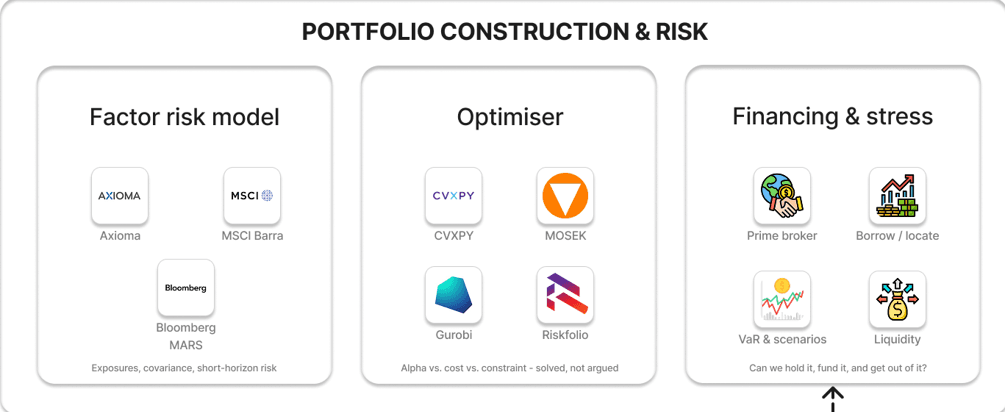
A signal is not a trade; it is merely a forecast. This module translates forecasts into mathematical reality.
- Factor Risk Models: The system passes the signal into institutional factor models (like Axioma or MSCI Barra). This splits the forecast into pure exposures, ensuring that "new alpha" isn't actually just hidden momentum risk the fund already owns.
- The Optimizer: The portfolio optimizer takes over, solving the complex math of Alpha minus Cost while strictly operating inside the Chief Investment Officer's predefined risk limits. The exact output is a calculated position size.
3. Pre-Trade Gate & Execution (The Deterministic Router)
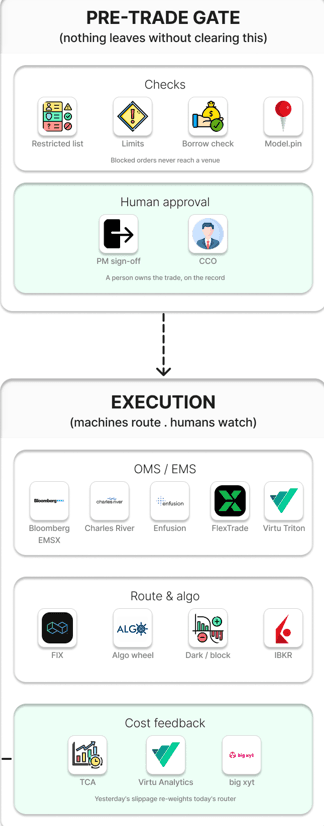
An AI must never have unchecked access to the market. Execution is heavily guarded.
- The Pre-Trade Gate: Before any order is placed, it hits the gate. It checks the restricted list, concentration limits, and borrow availability. Blocked orders never reach a trading venue.
- The OMS Constraint: Once cleared, the order routes exclusively through the Order Management System (OMS)—such as Bloomberg EMSX or Charles River.
- Execution Feedback: After the trade is executed, the fills are measured against the arrival price. This slippage data feeds back into the loop, re-weighting tomorrow's execution router.
4. System Integration: The Orchestrator Layer
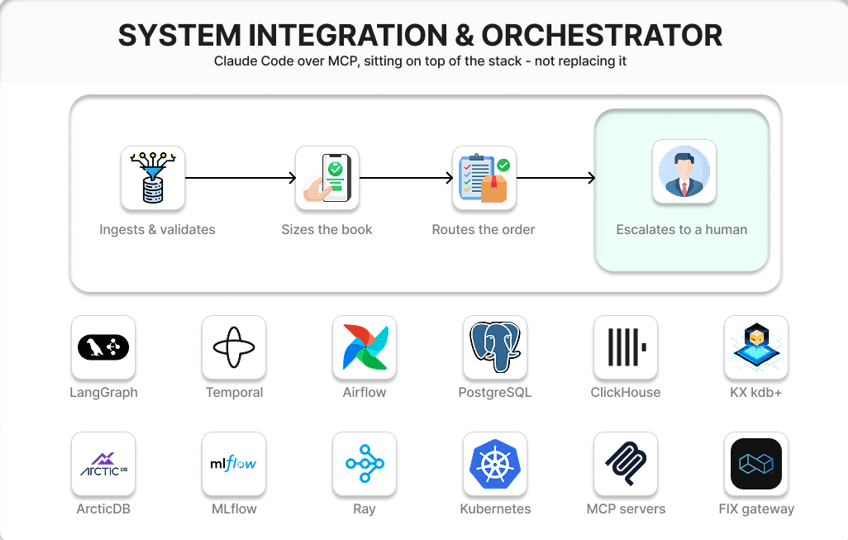
How does Claude actually manage this complex financial plumbing? The intelligence sits on top. Powered by Claude Code communicating via the Model Context Protocol (MCP), the orchestrator connects directly into the point-in-time data store, the risk models, and the OMS.
It acts as the system's brain: kicking off the daily loop, running the research, and drafting the portfolio rebalance. However, the most critical architectural constraint is absolute: The AI is strictly forbidden from routing around the OMS. It drafts the plays, but the institutional infrastructure executes them.
Conclusion
The next evolution of quantitative finance is not about building a smarter standalone trading bot; it is about deploying an intelligent operating layer across the entire fund architecture. By orchestrating research, risk, and execution through a unified AI framework—while strictly adhering to institutional OMS guardrails—quant funds can exponentially increase their alpha discovery rate without compromising deterministic risk management.