The future of business operations is closer than people think. It is not about inventing entirely new software; it is about fundamentally changing how existing software communicates.
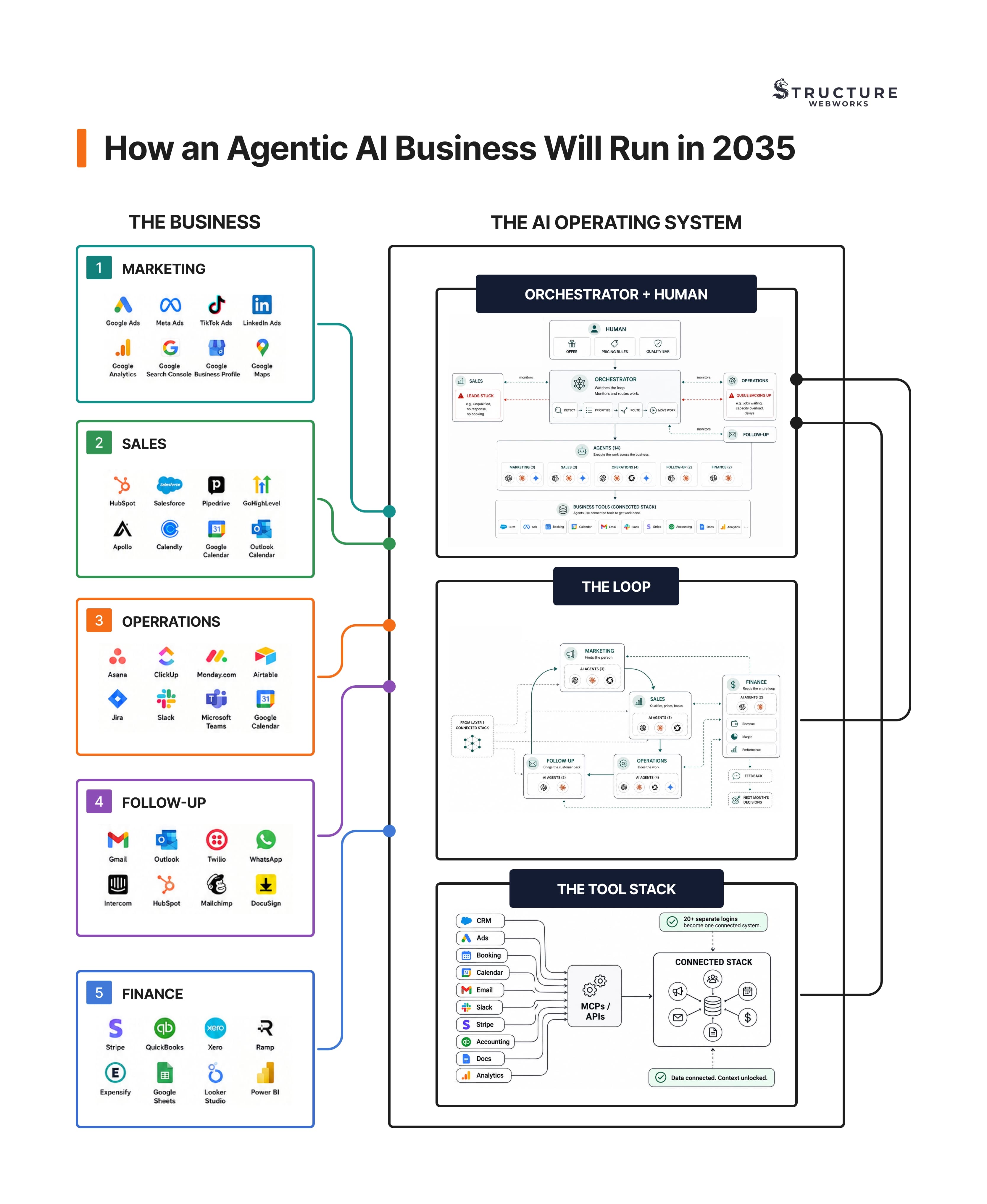
When you look at a modern company, the left side of this architecture represents The Business as it exists today: five core departments (Marketing, Sales, Operations, Follow-Up, and Finance) running on dozens of disconnected SaaS tools.
The right side represents The AI Operating System—the autonomous infrastructure that replaces human button-clicking with agentic workflows. By breaking this down from the bottom up, we can see exactly how a fully integrated AI business operates.
1. Layer 1: The Tool Stack (The Infrastructure)
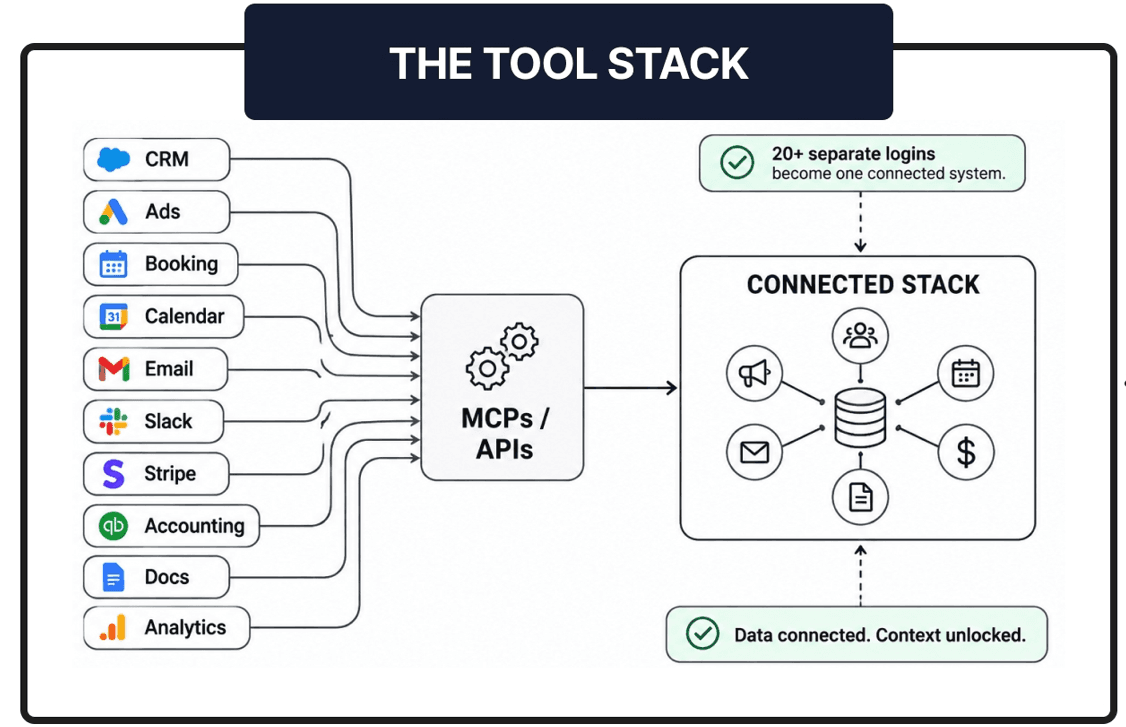
Every business currently pays for a tech stack: Ads, CRM, scheduling, communication, and accounting. Right now, these are simply twenty separate logins open in different browser tabs, requiring a human to manually copy-paste data between them.
In an agentic architecture, this changes completely.
- The Connected Stack: Through APIs and MCPs (Model Context Protocols), every single software tool is wired into a centralized context layer.
- Data Unlocked: The AI agents do not need a human to pass information back and forth. They can securely reach into any tool on that grid—pulling a lead from HubSpot, checking capacity in Monday.com, and generating an invoice in QuickBooks—autonomously and instantaneously.
2. Layer 2: The Loop (The Autonomous Pipeline)
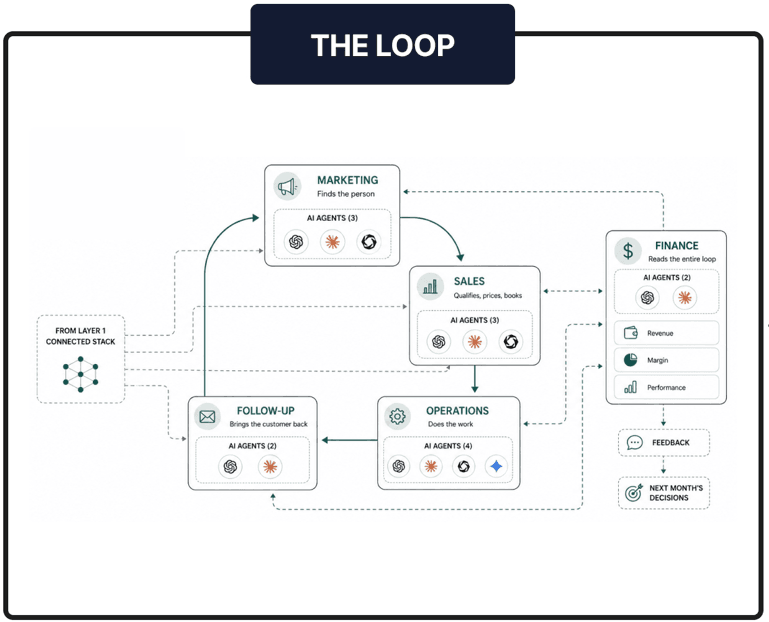
With the data unlocked, the system moves to execution. This layer contains 14 specialized agents distributed across the five core departments, operating in a continuous, self-feeding loop.
- The Workflow: Marketing finds the prospect and seamlessly hands them to Sales. Sales qualifies the lead, prices the job, books it, and passes the baton to Operations.
- Execution & Retention: Operations executes the actual work. The moment the job is marked complete, it automatically triggers the Follow-Up agents to retain the customer and request reviews.
- The Financial Feedback: Finally, Finance reads every single transaction across those steps and tells Marketing exactly where to allocate the budget for the following month based on real profit margins.
3. Layer 3: Orchestrator + Human (The Governance Layer)
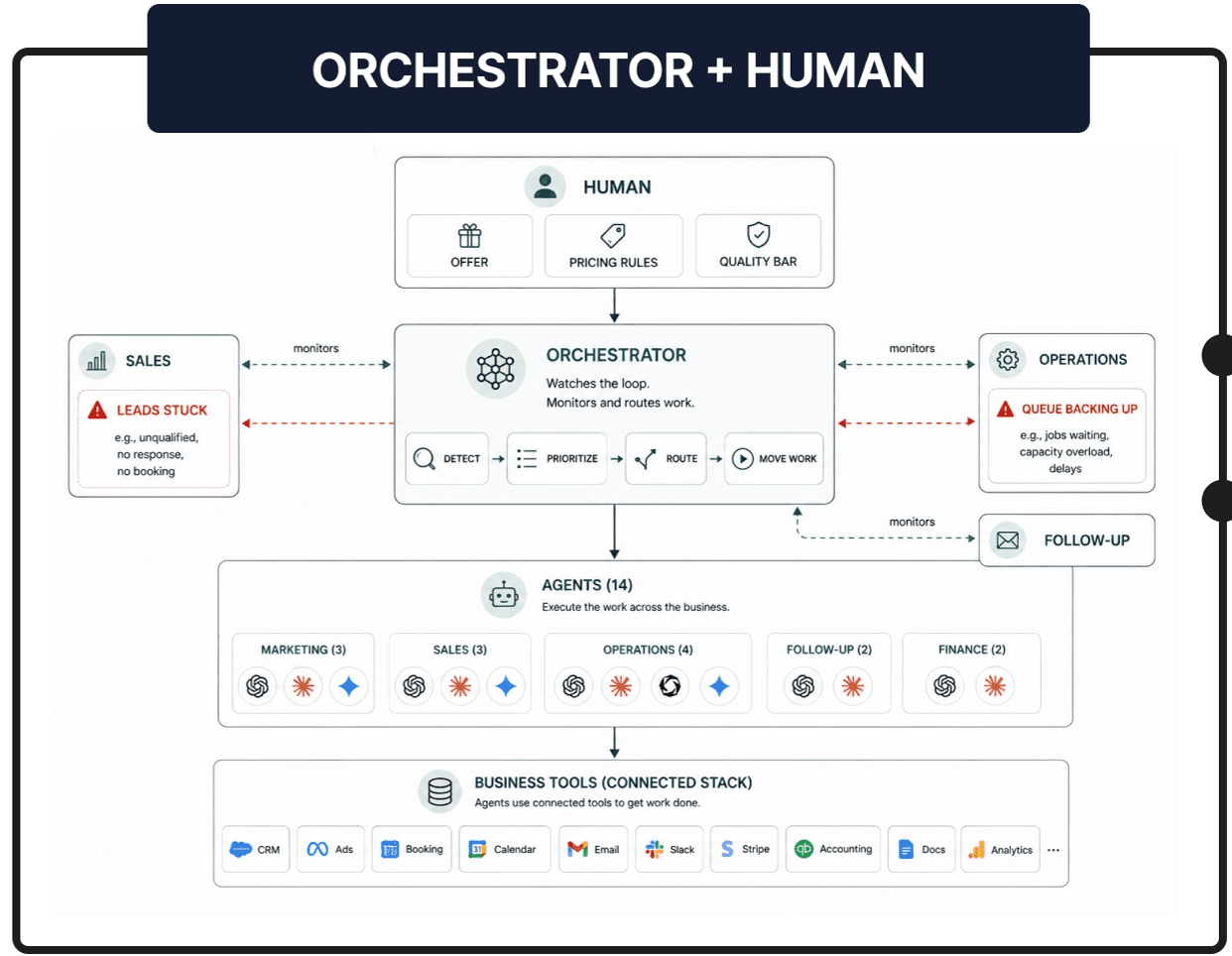
If agents are doing the work, who is managing them? That is where the top layer comes in.
- The Orchestrator: This master agent is not doing the ground-level work; it is watching The Loop. If leads start falling through the cracks between Sales and Operations, or if an execution queue starts backing up, the Orchestrator sees the bottleneck and reroutes the work before a human manager would even notice.
- The Human (The CEO): Sitting at the absolute top of the hierarchy is you. You are no longer operating the software. You own the Offer, the Pricing Rules, and the Quality Bar. The strategic vision and the final standard of excellence never leave your hands.
Conclusion
The next evolution of the enterprise is not about adding more tools to the stack; it is about connecting the ones you already have through an intelligent, agentic operating system. When an Orchestrator manages the operational bottlenecks and specialized agents execute the loop, the human CEO is finally freed from administration to focus purely on strategy, offers, and growth.