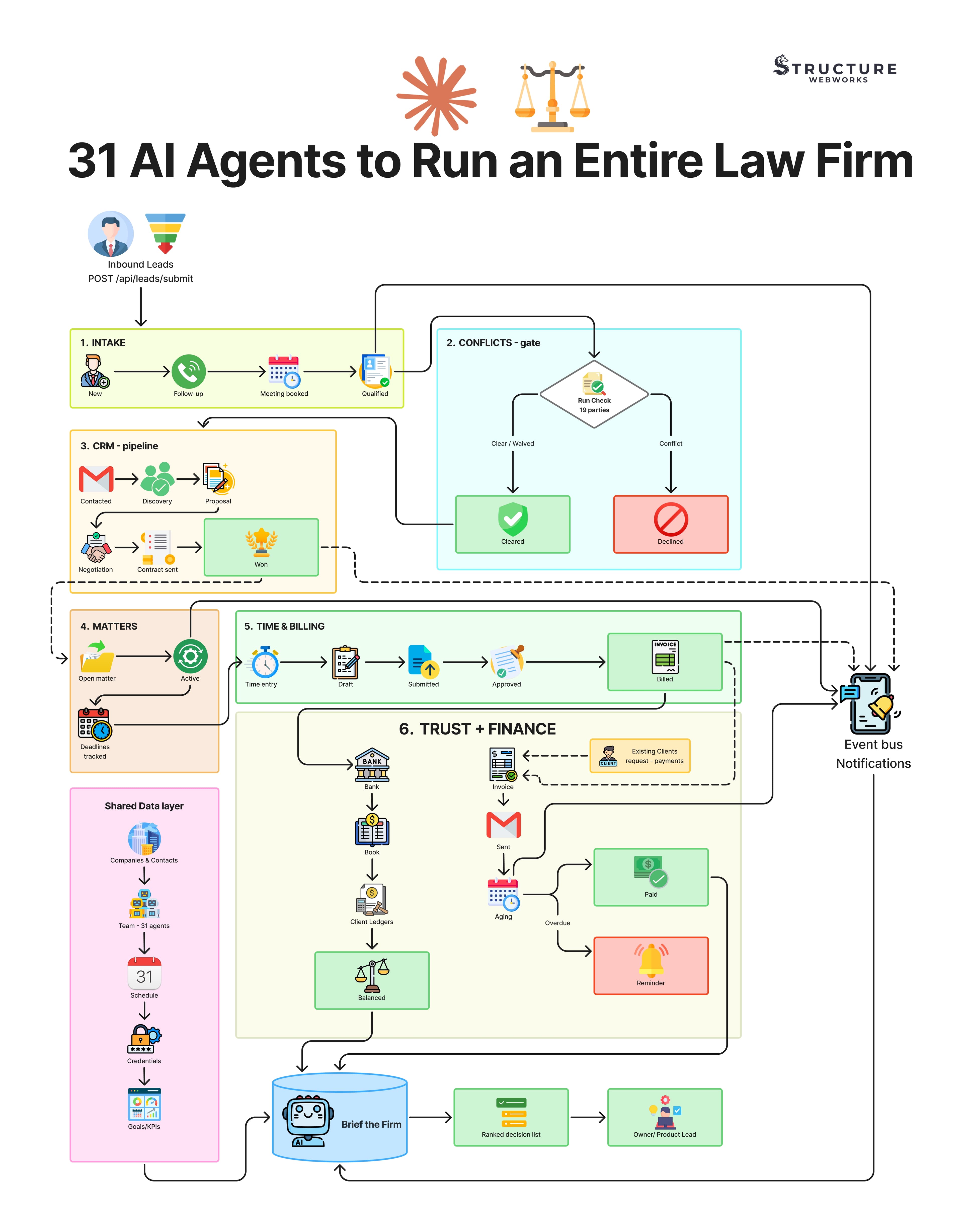
Law firms are traditionally bottlenecked by fragmented software and rigorous compliance requirements. What happens when you replace disconnected tools with a unified, autonomous infrastructure?
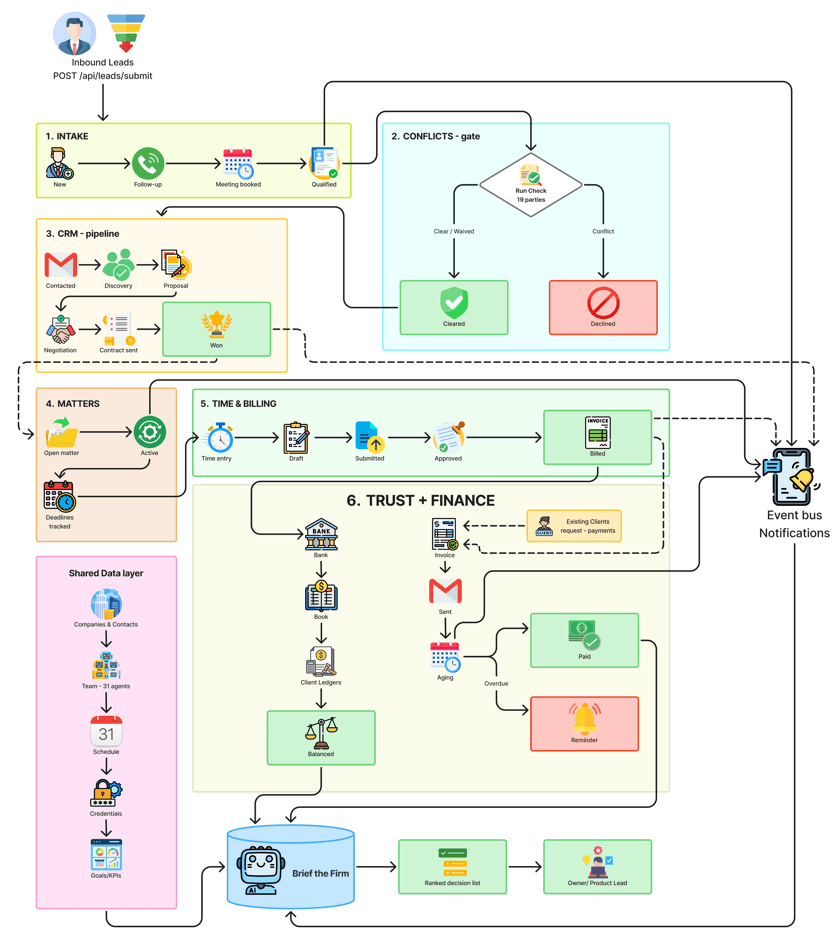
This is the architectural blueprint of a legal operating system where 31 specialized AI agents run the entire firm across six interconnected departments. From the first conflict check to the monthly trust reconciliation, every module communicates in real-time. Intake feeds the CRM, the CRM opens the matter, the matter feeds time and billing, and billing feeds trust and finance.
Here is a breakdown of how the core modules process data, and the central orchestrator that turns that data into daily decisions.
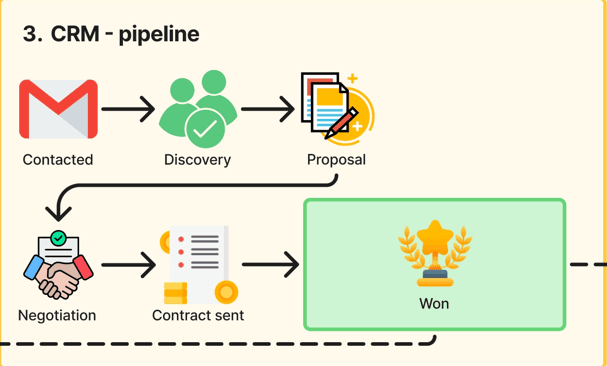
1. The CRM Pipeline (The Revenue Predictor)
.png&w=3840&q=75)
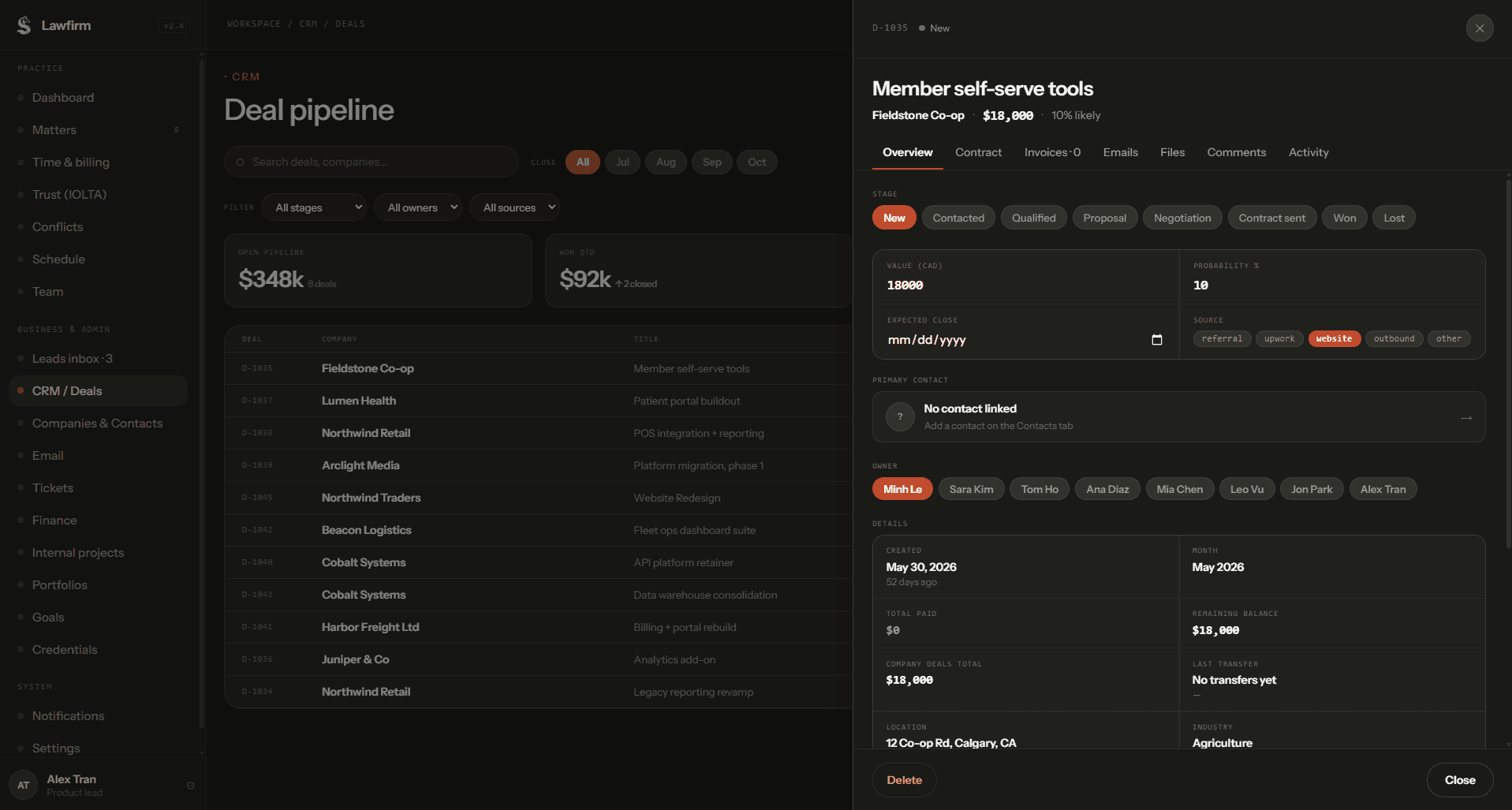
Law firms rarely track their pipeline with the rigor of a SaaS company. This AI-driven CRM module changes that.
- Probability Weighting: It actively tracks $348,000 across 8 open deals, but automatically weights the pipeline down to a realistic $211,000 based on historical probability and closing math.
- Attribution & Tagging: Every deal is meticulously stage-tagged and source-tagged. The system calculates a live 67% win rate and tells the partners exactly where referrals are converting better than inbound website traffic.
%20UI.png&w=3840&q=75)
2. Matters (The Operational Execution)
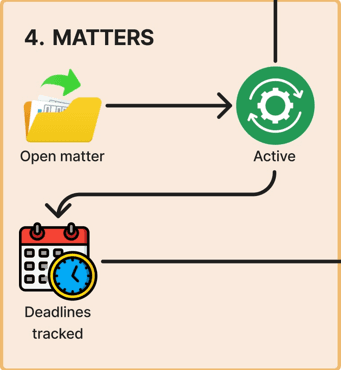
When a deal is won in the CRM, the system automatically crosses the Conflicts Gate (Module 2). Once cleared, it instantly opens a new active Matter.
- Practice Area Tracking: It manages 8 open matters across 6 distinct practice areas (litigation, corporate, employment, real estate, IP, trusts and estates).
- Financial Visibility: It tracks Work-In-Progress (WIP) in real-time, instantly identifying $35,000 in work that has been completed but not yet billed, while simultaneously monitoring $289,000 sitting securely in client trust accounts.
%20UI.png&w=3840&q=75)
%20Detail.png&w=3840&q=75)
3. Trust & Finance OS (The Money Engine)
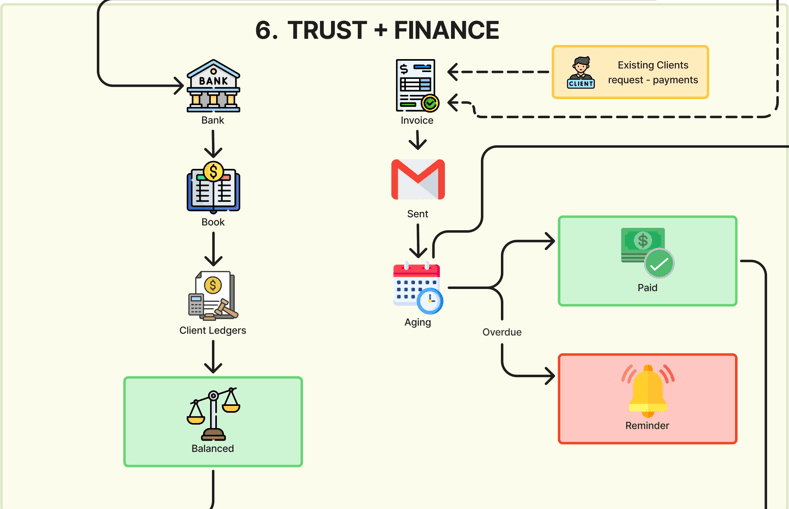
Legal accounting is notoriously complex due to strict trust compliance rules. This module handles the money with zero latency.
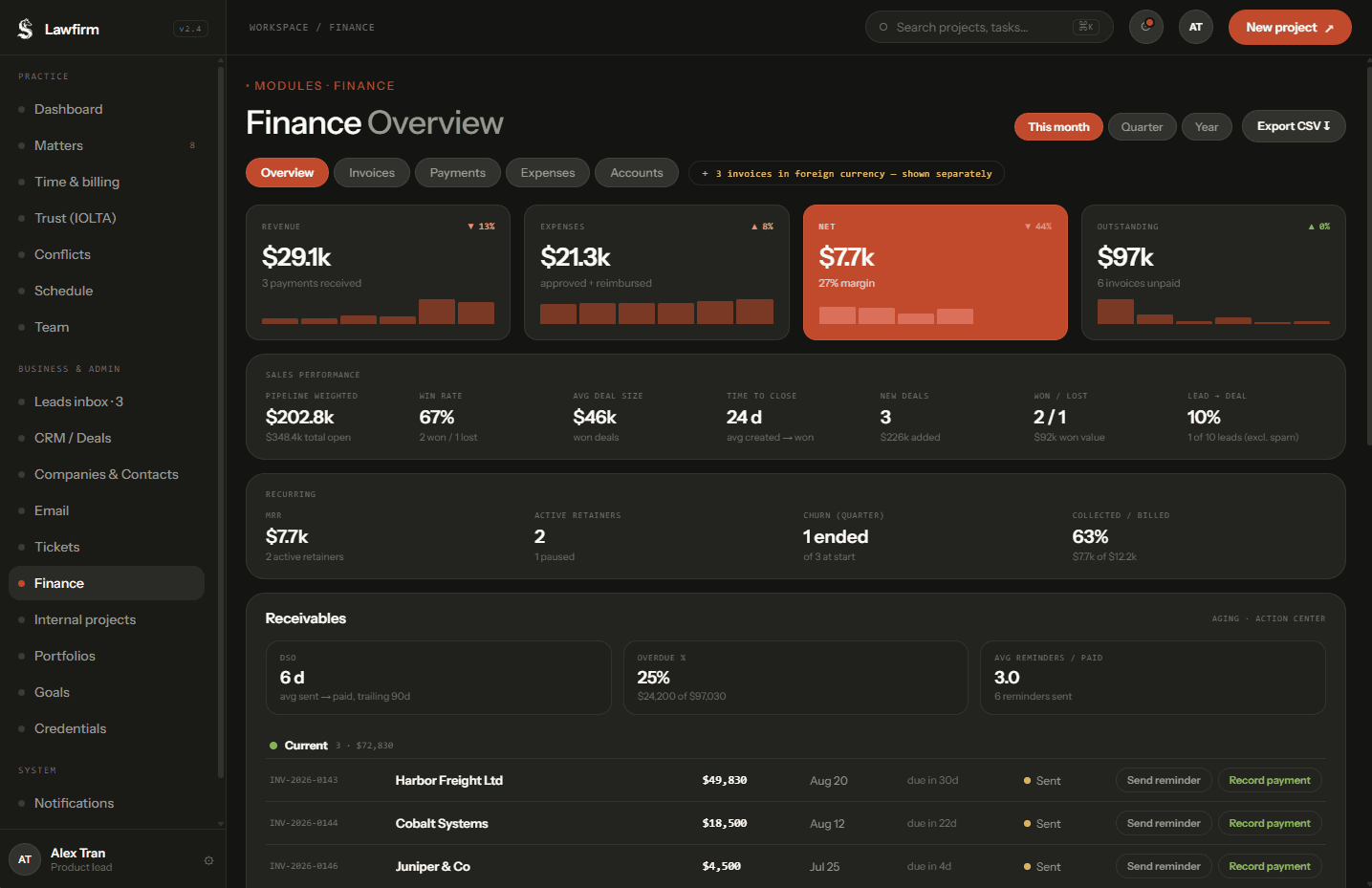
- Live Unit Economics: It tracks revenue, expenses, and net margins live.
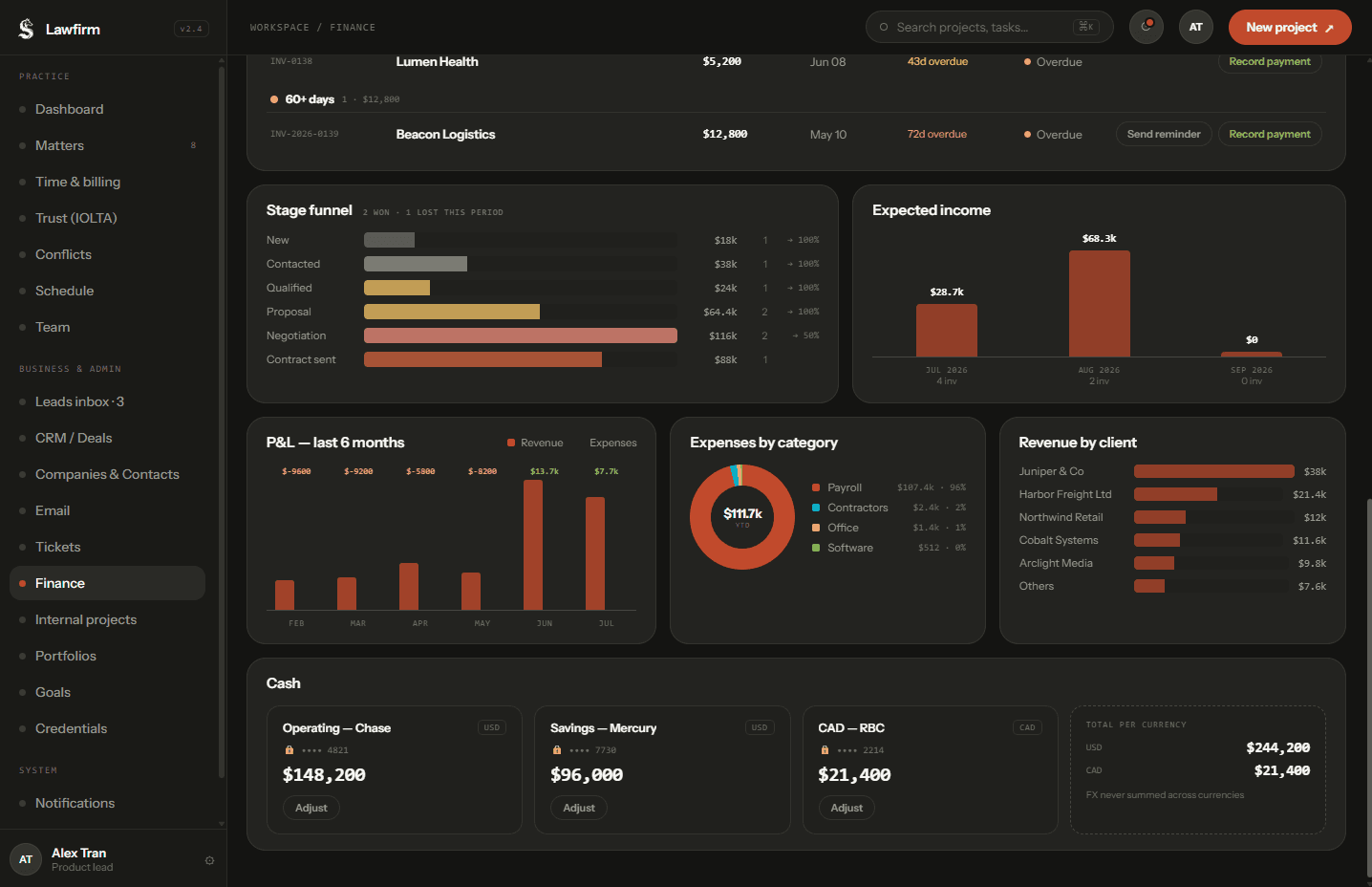
- Dynamic Aging AR: It monitors $97,000 in outstanding revenue across six invoices. It doesn’t just report a lump sum; it buckets the debt by age (Current, 1-30, 31-60).
- Actionable Alerts: It flags critical anomalies, such as a specific $12,800 invoice from "Beacon Logistics" that is exactly 72 days overdue, triggering automated follow-up sequences.
4. The Orchestrator: Brief the Firm
Having all this data flowing through a central Event Bus is powerful, but data overwhelm is a real threat to managing partners.
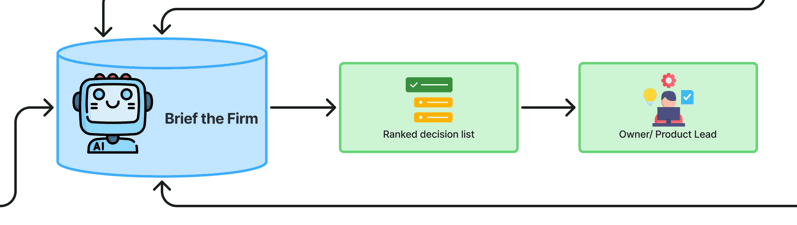
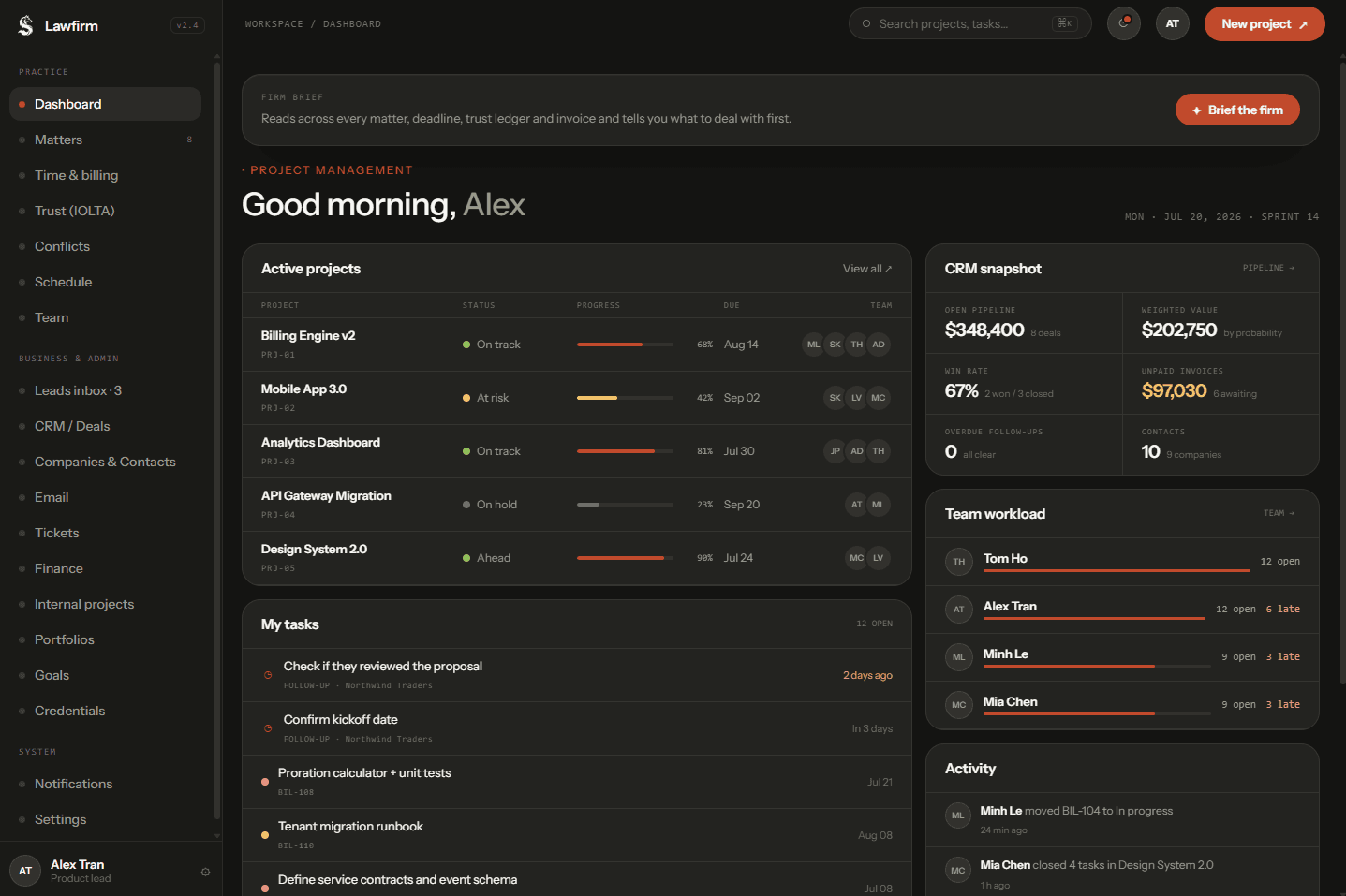
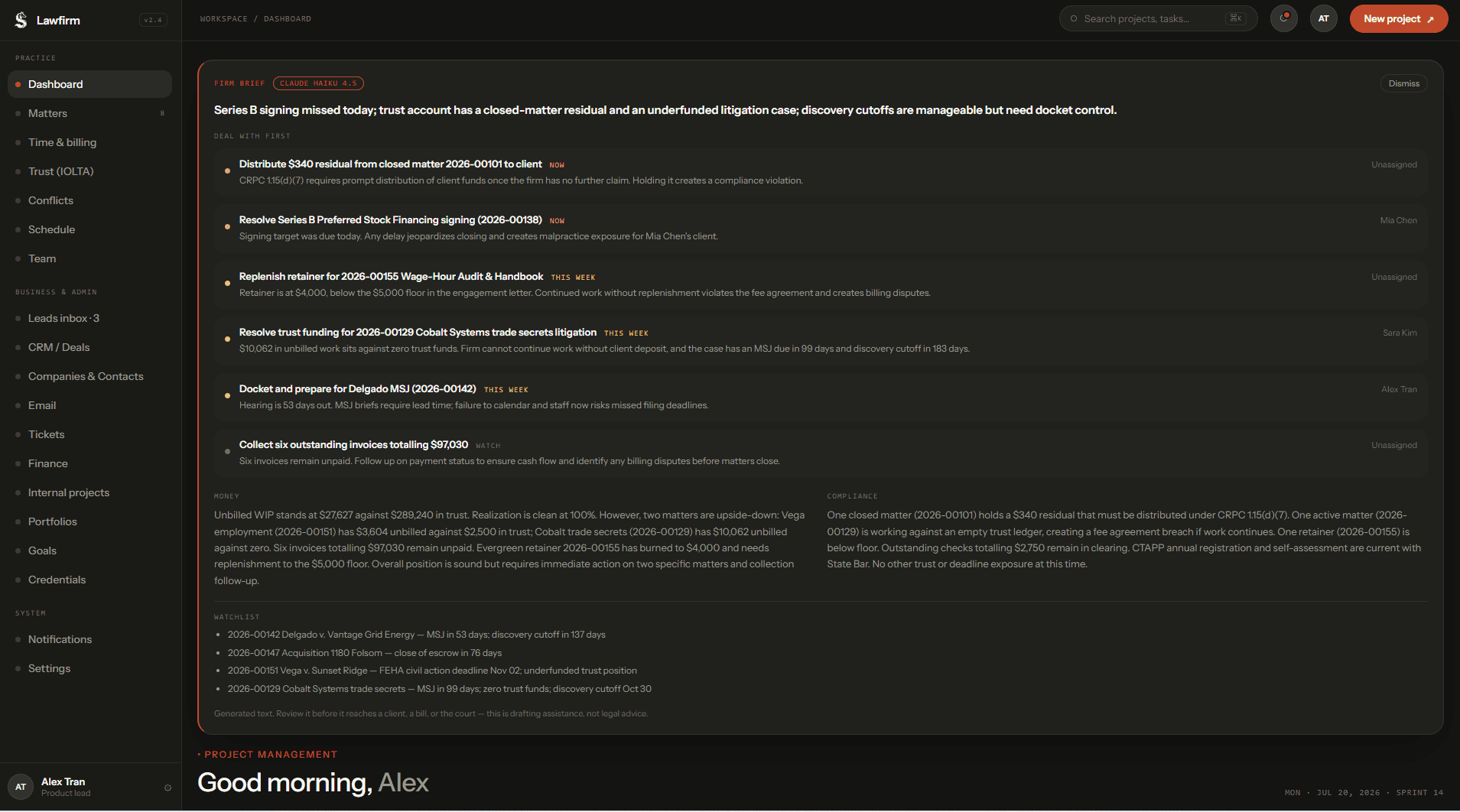
This is where the overarching orchestrator comes in: Brief the Firm. At the push of a single button, this master agent reads every open matter, every upcoming court deadline, every client ledger, and every overdue invoice across the Shared Data Layer.
It synthesizes millions of data points and hands the managing partner a single, Ranked Decision List. It tells the leadership exactly what they need to deal with first today.
It is not just another dashboard—it is a decision.
Conclusion
By structuring 31 AI agents into a cohesive, 6-department architecture, law firms can eliminate the operational bloat that eats into billable hours. When intake, matters, billing, and trust accounting speak the same language autonomously, partners can stop acting as administrators and focus entirely on practicing law.